
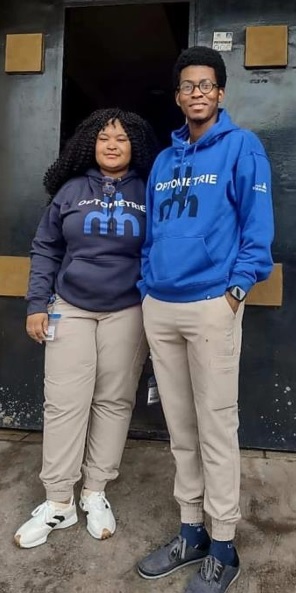
Testimonials of Anne-Christy Orcel and Jonathan Simon, Haiti Optometry Program Graduates
Testimonial: Anne-Christy Orcel, Optometrist
MISSION IN THE DEMOCRATIC REPUBLIC OF CONGO
Although I am still at the beginning of my career, I can already say that this experience in the Democratic Republic of Congo ranks among the most meaningful of my professional journey.
From the moment I arrived in the Democratic Republic of Congo, I was struck by the many cultural and human similarities that reminded me of my own path in Haiti. Despite the distance separating our two countries, I found familiar realities there: motivated students, sometimes limited resources, but above all a remarkable willingness to learn and to advance the profession.
Watching the students, I recognized in their eyes the same enthusiasm and curiosity that drove us when international professors and professionals came to share their expertise at the School of Optometry of the State University of Haiti.
Beyond their desire to acquire new knowledge, I also sensed in them a need for role models with whom they could identify. When you see people who come from a context similar to your own moving forward despite the challenges, it becomes a source of inspiration, motivation, and hope. I therefore felt a great sense of responsibility, but also an immense privilege, to be able to contribute, even modestly, to their training.
This experience was also extremely enriching on both a personal and professional level. Understanding a concept for oneself is one thing, but mastering it well enough to teach and convey it effectively is another. The exchanges with the students, their engagement, and their constant willingness to learn pushed me to give the very best of myself at every stage of this mission.
This mission reminded me of the full importance of in-person knowledge sharing. While virtual teaching offers extraordinary possibilities, nothing replaces the richness of human interaction, direct observation, and hands-on guidance in the field — particularly when it comes to developing clinical skills.
I sincerely believe in the potential of each and every one of these students, and I am convinced that they will contribute meaningfully to the development of optometry in the Democratic Republic of Congo. Their determination and commitment to their profession carry hope for the future of visual care in their communities.
Finally, I would like to warmly thank the partners behind this initiative, particularly Optometry Giving Sight and the Université de Montréal, whose commitment goes far beyond supporting a training program. Through their vision and their investment, they are helping to strengthen local capacities, foster the sustainable development of optometry, and build a better future for the population who will benefit from these essential services.
Testimonial: Jonathan Simon, Optometrist, Instructor
Francophone Optometry Program (Opto-Hub): Testimony on the Practical Training Mission in the DRC
A graduate of the School of Optometry of the Université d’État d’Haïti (UEH), the first and only institution of its kind in the country, created through an international consortium originally led by the Brien Holden Vision Institute and composed of: BHVI Foundation, UdeM, VOSH International, Charity Vision, Optometry Giving Sight, and l’Université d’État d’Haïti. Since 2022, the Université de Montréal (UdeM School of Optometry) has led the project, and the consortium has been reduced to UdeM, Brien Holden Foundation (formerly BHVIF), l’Université d’État d’Haïti, and Optometry Giving Sight as the main partner and sponsor.
In 2024, I had the honour of completing an 8-month internship at the UdeM School of Optometry with the goal of developing my capacity to train future optometrists locally, through the Queen Elizabeth II Diamond Jubilee Scholarships program administered by l’Unité de santé internationale (USI) at UdeM. Due to the current situation in Haiti, I am forced to teach Haitian students remotely from Montreal.
During an exchange with Dr. Luigi Bilotto, who is responsible for the project to establish optometry schools worldwide and serves as an international ocular health advisor at the Université de Montréal, my colleague Anne-Christy and I were invited to contribute to the training of the first optometrists in the Democratic Republic of Congo, as part of the inter-university partnership between the Université de Montréal, HONU University, and Vi-Zion MD. According to Dr. Bilotto, this initiative was a continuation of our train-the-trainer program, which he was supervising. Beyond my deep passion for passing on optometry skills, I was drawn by the strong historical and cultural ties between Haiti and the DRC, and I immediately accepted this opportunity.
We had begun jointly delivering the Clinical Optometry Procedures I course online, for which we needed to travel in person to deliver the practical component.
As Haitians, our arrival in the DRC quickly sparked particular interest among the students. For my part, I immediately noticed deep commonalities between Haitian and Congolese realities, which made it easy to establish a natural connection with the students. They saw in us people who understood their realities, their challenges, and their aspirations. We were more than teachers coming from abroad — we were, for them, a concrete example that it is possible to build high-level expertise while coming from a country facing challenges similar to their own.
The cultural and historical connection we share gave a special dimension to our role as instructors. Every interaction in the labs and every exchange during practical sessions was imbued with a sense of solidarity and mutual understanding.
We were deeply moved by the warm welcome from the on-site team, especially from rector Mr. Jean ZOZA, who came to receive us at N’djili Airport, and by the students’ genuine interest in our academic journey.
Just as in Haiti, access to eye examination services and qualified professionals remains limited for a large part of the Congolese population, due to a shortage of ocular health professionals. For me, travelling to the Democratic Republic of Congo to contribute to training a new generation of qualified eye care professionals represents far more than a simple academic support project: it is a genuine investment in international health and the improvement of quality of life for many people.
I invite you to read the article below from the Congolese press agency on the human resources challenges in ocular health in the DRC.
Santé oculaire : la RDC appelée à relever les défis en ressources humaines – ACP
During my stay in the DRC, I clearly observed the challenges facing the students. Pedagogical and clinical resources are not always as readily available as in North American universities, which requires students to show ingenuity and adaptability. However, far from being an obstacle to their learning, this reality seems to strengthen their determination.
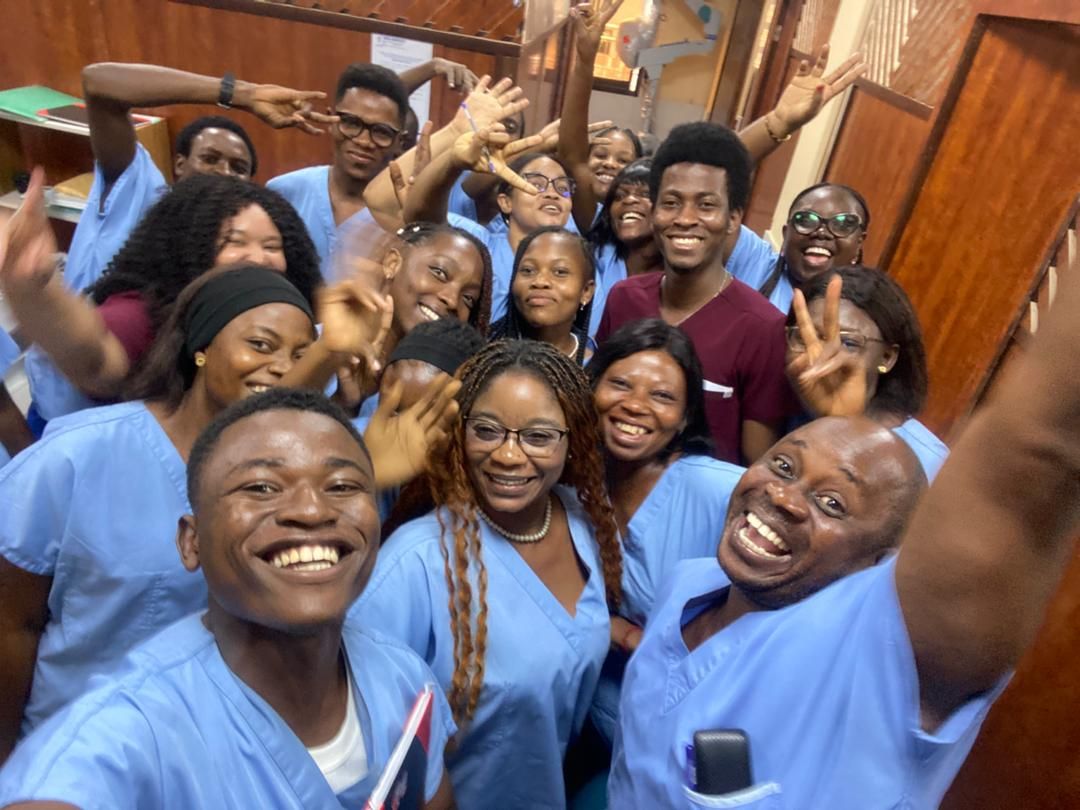
From the very first days, their desire to learn was evident. They demonstrated exemplary punctuality, great attentiveness, and considerable respect. Their enthusiasm for each technique covered was clear. It reminded us of our own experiences as students, particularly with Dr. Carole Melançon and Professor Jean-Marie Desroches, who were our first two international and Québécois instructors in Haiti. These students have a strong determination to develop skills that can have a concrete impact on patients’ lives in the Democratic Republic of Congo. I therefore take this opportunity to encourage students, residents of the UdeM School of Optometry, and Québec optometrists who are interested to get involved in this international project supported by the UdeM School of Optometry and its partners.
The students I met are not simply aiming to obtain a degree — they aspire to become agents of change within their communities. They are active across social media, and they distinguish themselves through their commitment to promoting optometry and raising awareness among the Congolese population about this noble profession and the challenges of ocular-visual health.
After a week of practical sessions, the time unfortunately came to leave the DRC and return to Montreal. I felt strongly that we had not only shared knowledge, but above all taken part in an enriching exchange of experiences, perspectives, and hope. This mission taught me that the international university cooperation initiated by the Université de Montréal, supported by its partners, is not limited to simply supporting ocular-visual care and training vision professionals in the Francophone world — it also aims to develop a set of sustainable solutions to meet primary eye care needs on a global scale.
I hold a particularly precious memory of my experience at HONU University. The passion, rigour, and ambition of the Congolese students inspire in me a profound optimism about the future of optometry in the Democratic Republic of Congo. I am convinced that a great many of them will become key leaders of the profession in the years to come and will play a central role in the fight to prevent avoidable blindness, both in the DRC and in Central Africa more broadly.