
Why Optometry for Uganda?
The Brien Holden Foundation has led the development of the optometry program at Makerere University in Uganda.
How will optometry benefit Uganda?
The population in Uganda as of 2020 is 43 million.
 Optometrists act as the first source of primary eye care to enabling early detection of serious eye conditions and diseases which may need referral. Optometrists will relieve ophthalmologists from the management of basic and common eye conditions, allowing them to focus on their areas of specialty – medical and surgical treatment.
The creation of skilled optometrists will in time increase the efficiency of eye care services in Uganda and improve the health system’s cost-effectiveness.
The eye care need and prevalence of uncorrected refractive error, myopia, cataract, glaucoma, macular degeneration in Uganda:
- 16 OCO/Cataract surgeons are practising in Uganda and they function in 14 of the 56 districts.
- At present there are 29 active ophthalmologists, serving a population of roughly 43 million people. Therefore, on average one ophthalmologist does serve a population of more than one million people. Considering the fact that about half do serve in the capital, the ratio for smaller towns and rural areas is even worse.
- There are about 207 OCO’s in the country and most only do presbyopic corrections. Those who go back for the 3-month OCO refraction course are the only ones who perform objective and subjective refractions.
- 8 Private Sector Optometrists are based in the capital, while 1 Optometrist is based in Ruharo Eye Centre in Mbarara. All are in private practice and have received their training outside the country.
- At present there are only two Ophthalmic Nurses in the country.
Secondary level: The 207 OCOs provide basic ophthalmic services, with some based in the regional referral hospitals. There is at least one OCO per district. 50 OCOs were trained in refraction in Phase 1 of NIURE program. The majority performs refractions but some of them hardly practice since they are usually supporting ophthalmologists in the ward/theatre or are out in the field performing clinical duties.
Primary level: Ophthalmic Assistants (OAs) provide eye care services at the county and sub-county levels. A limited amount of RE and LV services are provided in the hospitals. The majority of these services are provided by optometrists in the private sector in Kampala. Only 2 mission hospitals have hospital-based expatriate optometrists and LVTs.
Current status: evolution of optometry development in Uganda
2014: Curriculum approved by National Council of Higher Education. First intake (8 students admitted, 6 enrolled). LFTW starts supporting optometry course coordinator.
2015: 4 students admitted. LFTW supports with set-up of optometry office and equipment for pre-clinic and AVC. BHVI equipment delivered. University identifies space for pre-clinic and AVC.
2016: 4 students admitted. Teaching clinic/Pre-clinic launch with senior management from LFTW. AVC launch with UNSW. MOU signed with BHVIF, UNSW and Makerere University.
2017: 20 students admitted (including 10 government sponsored). Curriculum reviewed to fit in with the revised MBChB curriculum. UNSW IGD team visited Makerere and interacted with students and faculty.
2018: Optometry recognised and gazetted. Registration to begin in June. Pioneer students complete course (May 2018). Start internships. 8 government sponsored students admitted for 2018-19 intake. Private TBC.
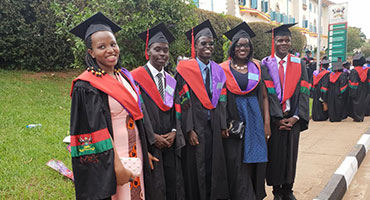
2019: Pioneer students graduate (January 2019). Five pioneer students graduated as the first Ugandan-trained optometrists for their country. They start the 25 week internship required by the Government to become a fully registered optometrist.
2020: Second cohort of students graduate (January 2020). Three pioneer students graduate to join the small but determined group of the first Ugandan-trained optometrists for their country. They start the 25 week internship required by the Government to become a fully registered optometrist.
 WestGroupe and Carl Zeiss Vision’s commitment to help people in need through the sale of each ValuePak pair has made a significant impact on vision in areas of need around the world. Their support has helped fund vital projects such as the establishment of a school of optometry in Vietnam, and equipment for the growing optometry program in Malawi. Both countries are benefiting through newly graduated optometrists who are now providing comprehensive eye exams where there was previously very little or no eye care available.
 Ver Bien para Aprender Mejor has been working in Mexican public schools for more than 21 years, doing screening for refractive errors and delivering eyeglasses to those children who need them. Optometry Giving Sight has been supporting their work for several years and that continues into 2020.
 The goal for Ver Bien in 2020 is to screen 1 million children in public schools in Mexico. They expect to provide over 300,000 pairs of glasses to children who suffer from a refractive error and other issues that can easily be corrected.
 Optometry Giving Sight is very pleased to again be supporting the Vision Impact Institute’s Kids See: Successs program for 2020. This initiative was first launched and supported by Optometry Giving Sight in 2016 to fight for mandatory comprehensive eye exams for children as they enter kindergarten.