
Each year, donations to Optometry Giving Sight (OGS) enable us to fund projects globally that provide immediate eyecare to those in need today, and expand optometry so vision care is available for years to come.
Building the Optometry Schools That Will Outlast Us
We’re sharing updates from five very different projects with a single throughline: the establishment and strengthening of optometry schools themselves. Spanning Nigeria, Nepal, Vietnam, and a network of Francophone countries, these stories showcase the deliberate work of building academic institutions capable of producing optometrists long after any single grant ends.
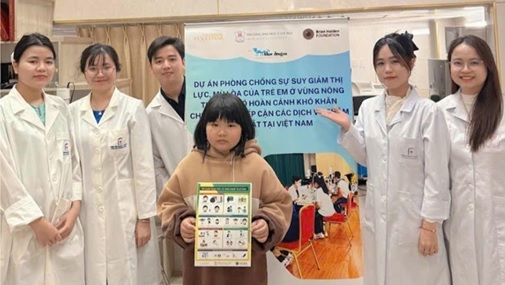
In Vietnam, the undergraduate Bachelor of Optometry program at Hanoi Medical University — supported by the Brien Holden Foundation with OGS funding — achieved formal government accreditation, establishing optometry as a recognized academic discipline for the first time in the country’s history. That accreditation has already opened the door to a new Master’s program, and it dovetails directly with a separate achievement: the Vietnamese government’s approval of an Optometrist Job Code, supported by OGS alongside our grantee partners, which allows locally trained optometrists to legally practice alongside ophthalmologists. In effect, Vietnam now has a fully recognized optometry profession built from the ground up.
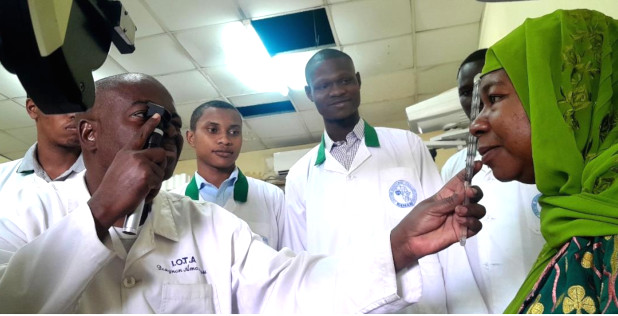
The Université de Montréal/Unité de santé internationale is tackling a related but earlier-stage challenge: building optometry education from the ground up across several Francophone countries. In the Democratic Republic of Congo, a formal partnership agreement with HONU University is now signed, equipment has been delivered, and local lecturers received their first hands-on training in how to teach clinical procedures themselves. In Mali, a new director at the Institut Ophtalmologique Tropicale d’Afrique has renewed conversations about launching a Master’s program. Even in Lebanon, where geopolitical instability has paused in-person visits indefinitely, the work of building toward formal governmental recognition continues online.
Despite extraordinary circumstances, Université de Montréal/Unité de santé internationale also continues to make progress in support of the UEH School of Optometry in Haiti. Port-au-Prince remains in a state of armed conflict and institutional instability, yet the first semester of 2026 launched on schedule in February, with both external and local faculty delivering courses remotely. The final students from the 2018–2023 cohorts have begun their clinical internships at the Cathy Pearson and Fortune Previl Memorial Clinic, and discussions are underway to formally accredit a residency program there — a pathway designed to transition graduates into faculty roles at the UEH School of Optometry, building long-term teaching capacity from within.
In Nepal, the Nepal Optometry Students Society is laying a different type of foundational groundwork: a functioning optical lab. Sourcing instruments internationally has meant navigating shipping delays and import hurdles most schools never have to think about. But the lab being built will give Nepali optometry students practical training they’ve never had access to before.
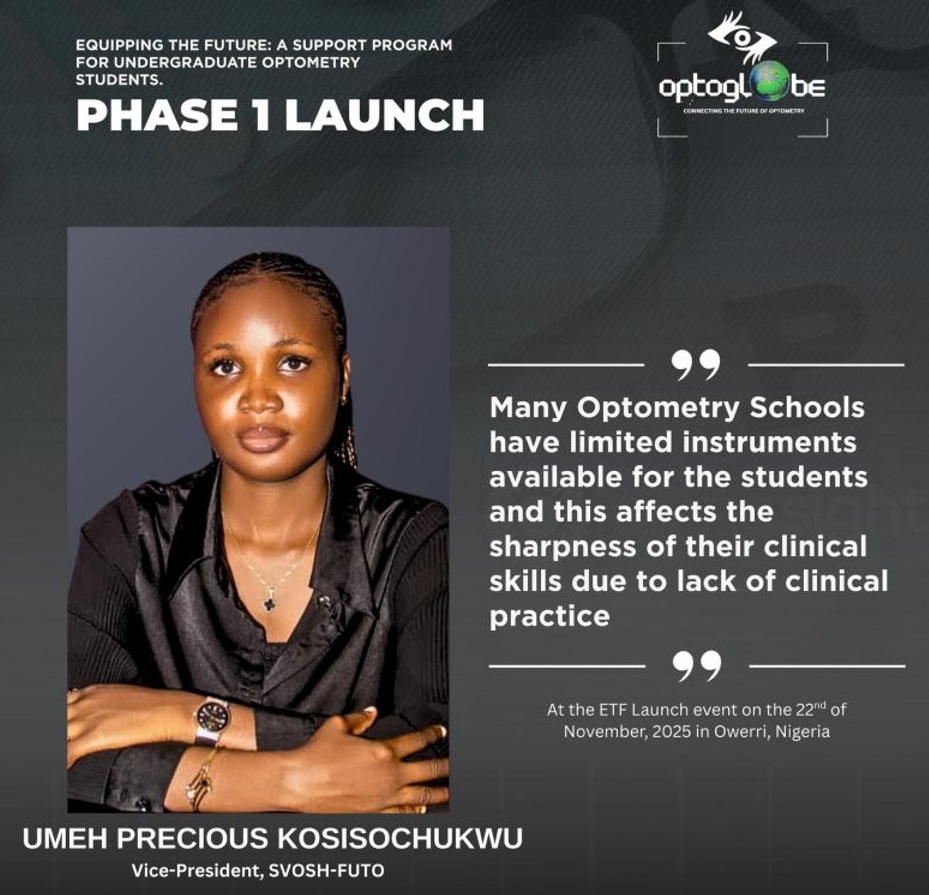
Meanwhile, in Nigeria, OPTOGLOBE is approaching the same issue from the student side. Faced with a smaller grant than requested, the Equipping the Future initiative pivoted toward gathering hard data on the barriers that optometry students worldwide face in accessing the clinical instruments their education depends on. That evidence — now live on a public dashboard — is already informing advocacy efforts and earning international attention, including an invitation to present at the IAPB meeting in Nairobi.
The work continues, across different countries and different stages of development, united by the belief that a profession is only as strong as the schools that train it. This is the kind of investment OGS is proud to stand behind.