
Cambodia: Sokunvortey’s story

Sokunvortey is 15 and studies at a high school in a community a short distance from Phnom Penh. She is a keen student but over the last three years seeing the whiteboard had become more difficult, and she noticed she could not recognize her friends from a distance.

“When I studied at grade 4, I was 12 years old then, I became aware of my eyes having difficulties seeing things clearly. Everything was blurry when I tried to see long distances. I’m not sure why but I kept this secret from my parents and tried very hard to see well. I think maybe I just didn’t want to bother them as they are very busy,” said Sokunvortey.
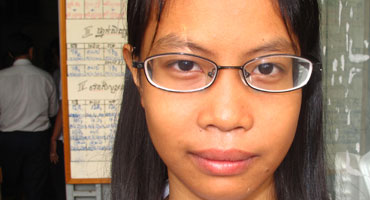
Sokunvortey lives with her parents and they work long hours.

“I got to know about the eye care services of the Brien Holden Foundation through attending school screening activities which our teacher had announced to all students. I firstly found myself hesitant to join as I was really afraid of having my eyes checked. I think maybe I believed it was only me who had this problem and I needed serious treatment, but now I understand that is not true,” she said.

“After the refractionist checked my eyes, I was told that I had high myopia astigmatism and it was explained that I needed to wear glasses but there was no need for any treatment or surgery. So I breathed a sigh of relief. I feel so much better now. Not only do I not need to worry any more, I can see well and live my life normally again,” Sokunvortey said smiling.

“I am very happy with my glasses. They help me to see everything clearly – especially when travelling anywhere. I can read and look at the teacher and letters on white board very well. Now I know how important glasses are. I would like to suggest to all students to have their eyes tested. Having good vision is the best,” she laughed.

The School Eye Health program currently operating in the communities surrounding Phnom Penh is funded by Optometry Giving Sight.

Building capacity in Cambodia

The project in Cambodia has been designed with sustainable strategies and is delivering eye care in a comprehensive and effective way.

In providing capacity building in eye health screening, training has been conducted for 25 teachers from 15 schools in Phnom Penh as well as for 10 staff members at the Ministry of Education, Youth and Sport (MoEYS) School Health Department. Eye screening programs are developing in three schools. This will enable trained staff to be aware of eye problems and recognise them in students, teachers and staff. They now have the capacity to be involved in screening activities and refer students to appropriate services.

“I am really happy to be invited by the Brien Holden Foundation to attend the training,” said Vice School Director Mr. Srouch in Phnom Penh. “I think the course is really good and it has given me the skills to be aware of basic eye problems, what signs to look for and when a referral is needed, and I now know the appropriate places to refer the students to.”

This activity is in line with the action plan of the National Program for Eye Health/Ministry of Health to prevent blindness from refractive errors and provide low-vision services through routine screening of school children at secondary and high school levels. The model of screening developed with the MoEYS and teachers in this project can be used in other areas of Cambodia to meet the goals of the National Plan for the Prevention of Blindness.

School Vice Director Mr. Srouch also added that, “I now know with school screenings, I have the skills to identify students and teachers alike who have refractive error or other eye problems. They can then be referred and fitted with a correct pair of glasses. It is a social and charitable contribution to the community by the Foundation and their funding partner Optometry Giving Sight.”

Bangladesh: Habib’s story

Habib Habib is a 13-year-old boy who lives in a village called Khalishapur in northern Bangladesh. He is one of five children in a very poor family. Although Habib’s parents own their simple house, they have no land for cultivating rice or other crops. Habib and his father and brothers must find whatever work they can as day labourers.
In recent years, Habib realized that he could no longer see clearly. He told his parents that he couldn’t see but they thought they were too poor to access any treatment.

However, one day the Symbiosis Primary Eye Care Project (SPECS) held a preschool vision screening in Habib’s neighbourhood. Habib was curious and went along to see what was happening. When he saw that the SPECS staff were checking the students’ eyes, he asked whether they could test his eyes also.

The SPECS staff agreed to examine Habib’s eyes and found that he had a cataract in his right eye. They advised him that he needed to have an operation to restore his sight. Although glad that his vision problem could be cured, Habib and his family were very concerned that with their meagre resources, they would not be able to afford the surgery.

Through their good relationship with a district eye hospital, the staff of SPECS were able to arrange subsided surgery for Habib, as well as transport to and from the hospital. Habib’s surgery was successful and then he received glasses to give him the best possible vision. Now that he can see well, Habib is working to earn an income and is able help his family. He and his family are very thankful to SPECS and to Optometry Giving Sight donors for helping to fund the project.

Eritrea: Finan’s story

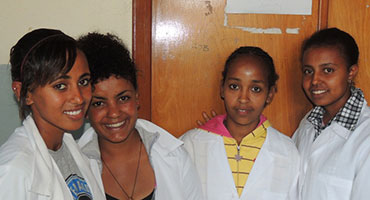
Finan is in her second year of studying for her diploma in the Asmara College of Health Sciences optometry program.

The program forms part of a five-year project which aims to contribute to the development of optometry in Eritrea by training 75 students to become optometric technicians and placing them in district hospitals; training 35 degree-qualified optometrists; establishing six to eight vision centers; and providing services to over 48,000 people.

Finan is one of the 75 students that will eventually graduate as an optometric technician, and she is overjoyed at the opportunity. “I can greatly empathize with those that suffer from avoidable blindness,” she said. “I also had poor vision for two years before receiving help, so I know how difficult it is to live a full and successful life when you can’t read or write because of poor vision. The worst thing of all is that people suffer needlessly – if they had access to an eye examination and a pair of glasses, they would be able to live normally again.”

When Finan heard of the optometry program at Asmara University, she knew she had found her calling in life. “I wanted to spend my life serving those people who struggle with vision problems. Doing work like this makes me feel that I am changing people’s lives for the better, so it is extremely fulfilling.”

“I find the program to be truly fascinating. Providing people with the gift of sight really instils hope in them and encourages them to pursue the dreams they thought were long gone. We give them light in life,” she said.

Finan is very grateful for the opportunity to study to become an optometric technician. “I will be the happiest person in the world when I graduate. I cannot wait to begin my career in optometry,” she concluded.

The current program operating in the optometry department at the Asmara College of Health Sciences in Eritrea is funded by Optometry Giving Sight and supported by the Brien Holden Foundation.

Bangladesh: Sabbir’s Story

Sabbir is a 6-year-old boy in first grade at his local government primary school in rural Bangladesh. Sabbir’s father has a tree nursery and earns just enough to feed the family. Sabbir is the only son in the family, so his parents had high expectations of him doing well at school.

SabbirSabbir was not doing well however, as he was unable to see the blackboard in his classroom. He also found it difficult to participate in activities with other children in the playground. Sabbir did not realize that he had an eye problem, and he never explained to anyone that he could not see. It was a difficult time for Sabbir, and his family were very troubled that he could not do well at school.
One day Sabbir’s teacher attended a ‘Teacher Training Seminar’ at the Symbiosis Primary Eye Care Project (SPECS) project. He learned about many common eye problems affecting young children, including the signs that a child may need glasses. Sabbir’s teacher recognized that Sabbir probably had an eye problem and discussed this with Sabbir’s father, advising him to take his son to the SPECS clinic.

At the SPECS clinic, Sabbir had a full eye examination which revealed that he was very short-sighted and needed glasses. The SPECS clinic provides eye testing and glasses at no cost to children from poor families like Sabbir’s.

Everybody was amazed at the difference that glasses made to Sabbir! Now he can see the blackboard and perform well at school, and he can also play with the other children now that he can see properly.

By educating teachers about eye problems affecting children, everybody in the community benefits. SPECS also conducts vision screenings of primary school children and gives teachers the equipment and training necessary for them to conduct an annual screening of their students in the future.

Malawi: Samuel’s story

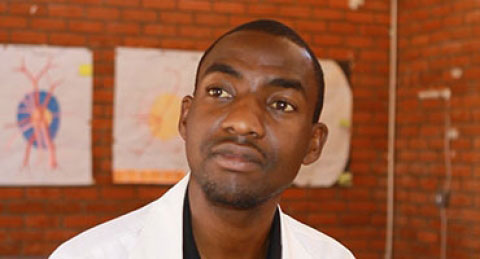
After a long ambition to pursue a career within the medical sciences, Samuel Chagwadira became one of Malawi’s first ever optometrists in 2012. Samuel, along with four of his classmates, was among the very first graduates from the Malawi School of Optometry at Mzuzu University.

As one of the first students in the program, Samuel remembers the early challenges when the university had limited equipment and resources. With the successful development of the School of Optometry, Samuel is now able to look towards even further study.

“My goals are to pursue my Masters and then my PhD, and to offer my services to my country and to Africa as whole,” he said. “The optometry program is a beautiful thing.”

Samuel

Samuel said that graduating was like a dream come true, and that he will always cherish the memories of his time with lecturers and classmates.

“To be part of the first group of graduate optometrists in Malawi feels great,” he said. “It is history in the making; we’ve written history!”

Optometry Giving Sight was one of the funding partners that aided in the establishment of the Malawi School of Optometry.

Sri Lanka: Mrs Liyanage

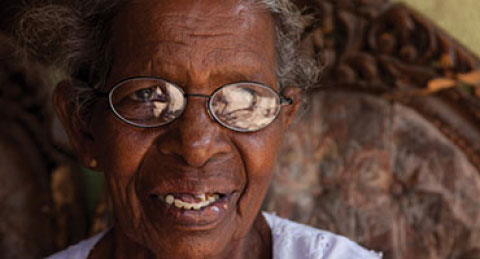
Mrs. Liyanage is the sole carer for her ailing husband. Her eyesight is vital in ensuring her and her husband have food and are safe. Her vision was causing her problems. She was struggling to see well enough to effectively take care of her husband and complete household chores.

Her inability to safely navigate her community was causing her distress.

“My vision problems made it difficult to do my housework. I couldn’t look after my husband well,” Mrs. Liyanage said with concern.

In a transforming moment, Mrs. Liyanage had her eyes tested and was fitted with a pair of glasses. After many years struggling to see clearly, she can now safely and competently do all the things she needs to do in order to take care of her husband.

After receiving her glasses, Mrs. Liyanage smiled with great relief and said, “Now I can look after my husband well!”

With no children to provide support, the Liyanages are an elderly couple completely reliant on one another. The importance of Mrs. Liyanage having clear vision could not be underestimated.

Thanks to a simple eye examination and pair of glasses, Mrs. Liyanage is confident her husband’s care needs will be met well into the foreseeable future.

The Giving Sight to Sri Lanka program is supported by Optometry Giving Sight.