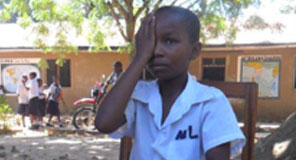
 Maadia is an eleven-year-old girl who has been experiencing poor vision for just over two years. Although she spoke to her parents about her failing sight, they were unable to help her due to their financial situation.
“My parents felt really bad, but they said they couldn’t do anything,” explained Maadia. “They didn’t have enough money for me to go to the hospital, so they said I had to wait until they had money. I knew it would be a long time before I could get my eyes checked. I lost hope that I would ever see normally again.”
Maadia was therefore thrilled when she found out her teachers would be participating in the School Eye Health Program, implemented by the Brien Holden Foundation and the Tanzania Ministry of Health, and funded by Optometry Giving Sight. Teachers from schools around the Bagamoyo District of Dar es Salaam were trained in eye health education and were also taught how to screen the children’s eyes and refer them for treatment when needed.
The School Eye Health Project offers eye screening and refraction services for free, and when a child is found to have refractive error or is found to need any medication or glasses, the project will cover all expenses.
Maadia was very happy and surprised when her teacher told her about the project. “I was the first in line to get my eyes checked,” she laughed. “I was so excited! And my parents were so happy for me.”
After her screening, Maadia was identified with low vision and was referred to Mlandizi Vision Centre for further tests.
Maadia was delighted that she will now receive the treatment for free. “I am very happy, and I have high hopes that I am going to be treated and will be able to read easily. I will be comfortable and able to sit in any position in my class. I will also be able to read anything from the board and my performance in school will greatly improve,” Maadia said excitedly. “My life will be wonderful,” she said smiling.
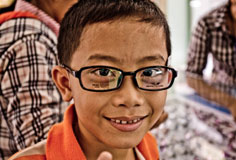 “My new glasses make me feel so happy,” said Trung, a nine-year-old boy from the southern province of Ba Ria-Vung Tau in Vietnam. Trung tells his story of the daily struggles he experienced for several years due to his poor vision.
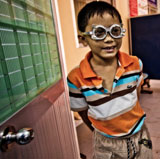 “I hoped that I would grow out of it soon,” Trung said. “But now I know that I don’t have to wait anymore. With my new glasses I can see everything very well and so school will be great. Before, I couldn’t see the lesson board even though everyone else could,” he said.
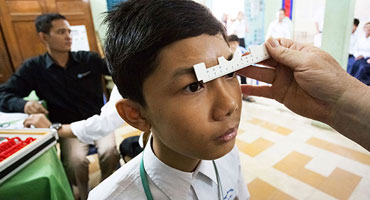 Lyhour is a 14-year-old from Phnom Penh in Cambodia who attended a school screening program that visited his high school. The program was funded by Optometry Giving Sight and supported by the Brien Holden Foundation.
 In providing capacity building in eye health screening, training has been conducted for 25 teachers from 15 schools in Phnom Penh, as well as for 10 staff members at the Ministry of Education, Youth and Sport (MoEYS) School Health Department. Eye screening programs are developing in three schools. This will enable trained staff to be aware of eye problems and recognize them in students, teachers and staff. They now have the capacity to be involved in screening activities and refer students to appropriate services.
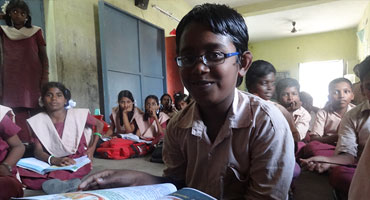 12-year-old Omar Faruk was very excited about his new pair of glasses, which have not only enabled him to see the blackboard clearly, but also improved his batting skills on the cricket field! Omar’s life changed dramatically following an eye examination at the vision screening camp organized by the India Vision Institute (IVI), with support from Optometry Giving Sight, at his government-run school in his locality.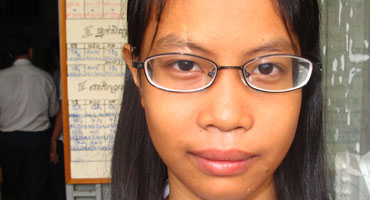
 Habib is a 13-year-old boy who lives in a village called Khalishapur in northern Bangladesh. He is one of five children in a very poor family. Although Habib’s parents own their simple house, they have no land for cultivating rice or other crops. Habib and his father and brothers must find whatever work they can as day labourers.
 Sabbir was not doing well however, as he was unable to see the blackboard in his classroom. He also found it difficult to participate in activities with other children in the playground. Sabbir did not realize that he had an eye problem, and he never explained to anyone that he could not see. It was a difficult time for Sabbir, and his family were very troubled that he could not do well at school.